

Skip to content
Orange background with three connected white building blocks and the text “9 Industry, Innovation and Infrastructure.” Represents the development of resilient infrastructure and sustainable industrialization.
Navy background with five interlinked white circles forming a flower-like shape, and the text “17 Partnerships for the Goals.” Illustrates the goal of strengthening global partnerships to support sustainable development.

KTU Research Team Welcomes a Robot Dog: Helping Researchers Explore How AI Interacts with the Real World

Important | 2026-09-30

The research infrastructure of the SustAInLivWork AI Centre of Excellence, coordinated by KTU, has been expanded with a Unitree Go2 quadruped robot. The advanced robotics platform will enable researchers to develop artificial intelligence (AI), autonomous systems and robotics solutions and test them in real-world environments.

Quadruped robots can operate in environments where traditional wheeled platforms face difficulties, navigating uneven surfaces, slopes and obstacles while adapting to changing surroundings. These capabilities mean that such systems can be used not only for scientific experiments but also for practical tasks, such as inspecting manufacturing, energy or transport infrastructure and monitoring the environment or animals.

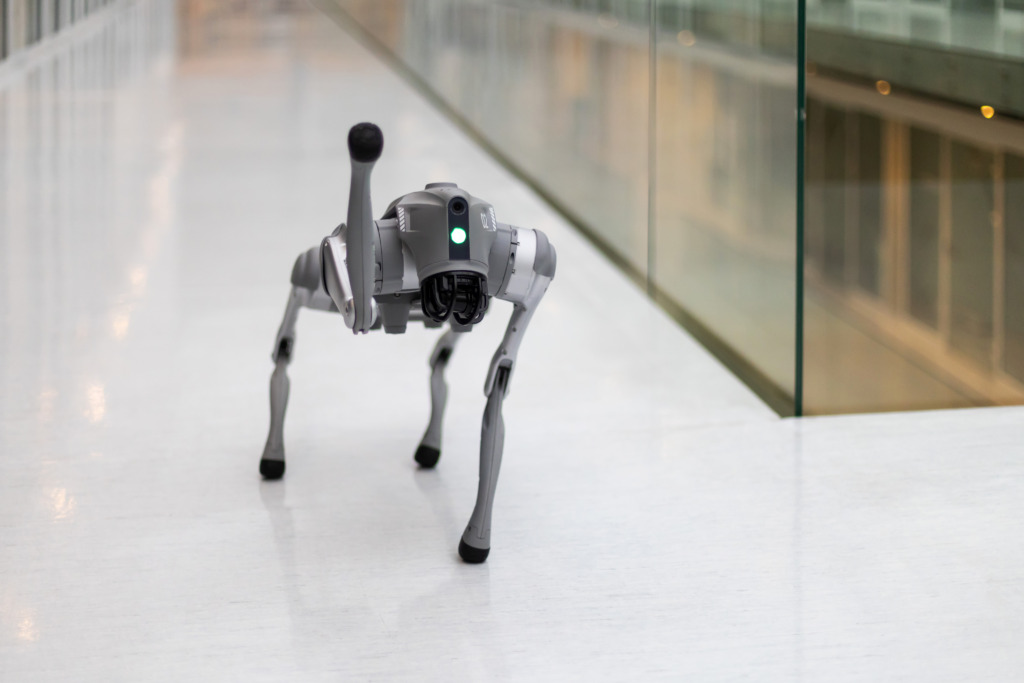
The Unitree Go2 observes its surroundings using LiDAR and visible-light cameras. The laser sensor enables it to determine the position of surrounding objects and their distance from the robot, detect obstacles and navigate its environment. According to Dr Rytis Augustauskas, Head of the AI Research Hub at SustAInLivWork, the ability to programme the robot is particularly important for researchers.
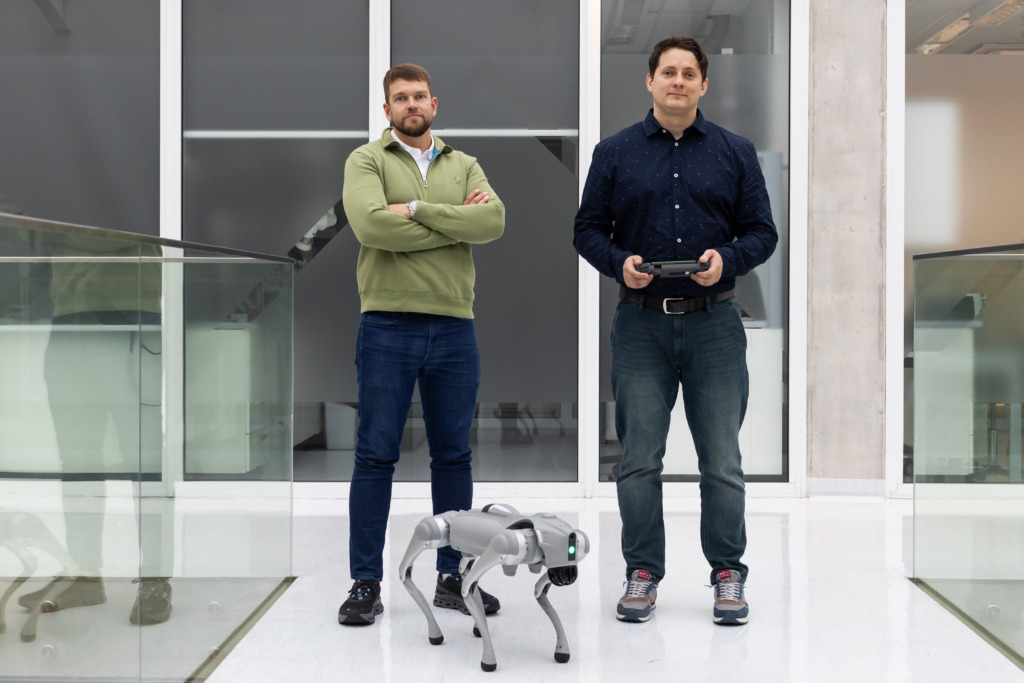
A Unitree Go2 Quadruped Robot

“If the platform cannot be programmed, it requires an operator to control it, meaning that the robot directly depends on human decisions. Being able to programme it can give the robot autonomy: its operation can be based on algorithms that interpret the environment, enabling the system to make decisions and plan the robot’s movements accordingly,” explains Dr Augustauskas.

This allows researchers to use the robot not as a device designed for a single specific task, but as an experimental platform for developing and testing solutions for environmental perception, navigation, autonomous movement, sensor data analysis and other applications.

Giving Artificial Intelligence A ‘Body’

According to Jonas Paulauskas, Head of Strategic Management Hub at SustAInLivWork, robotics plays an important role at the Centre because it allows AI solutions to move from the digital environment into the physical world.

“The Centre’s vision is to work with the latest technologies and find ways to apply them in practice. Robotics plays an important role here because it allows us to give the artificial intelligence solutions we develop a ‘body’,” says Paulauskas.

According to him, various robotics solutions could in the future be integrated into the Centre’s priority areas of activity: transport, medicine, manufacturing and energy. However, their potential applications are not limited to these areas.

“What matters most to us is not the name of the sector itself, but the real-world problem that we can solve using science and technology,” he says.

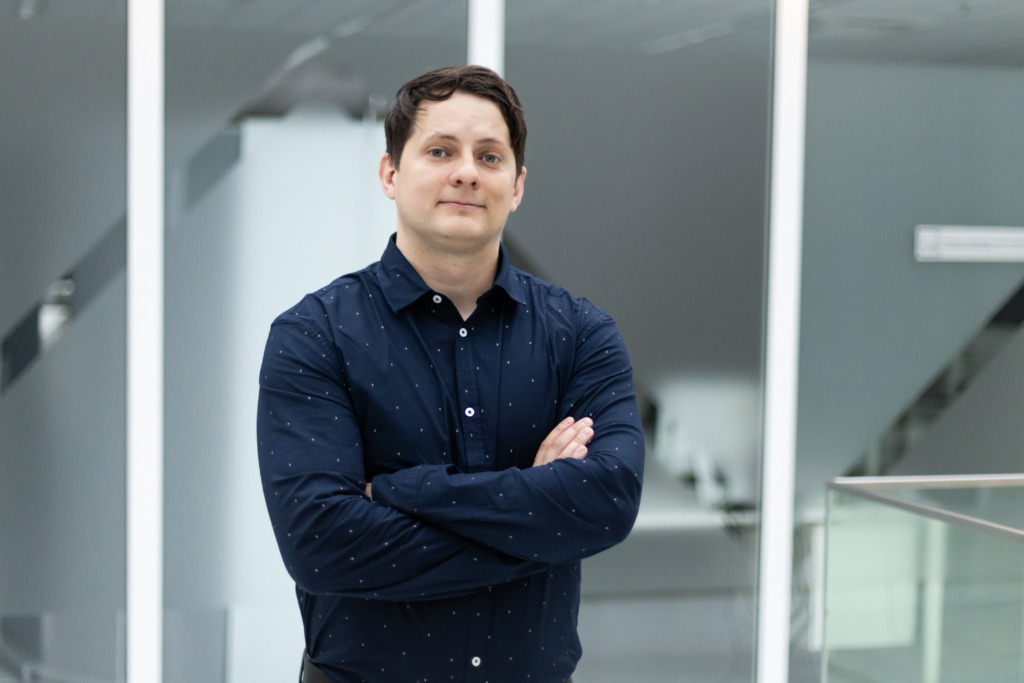
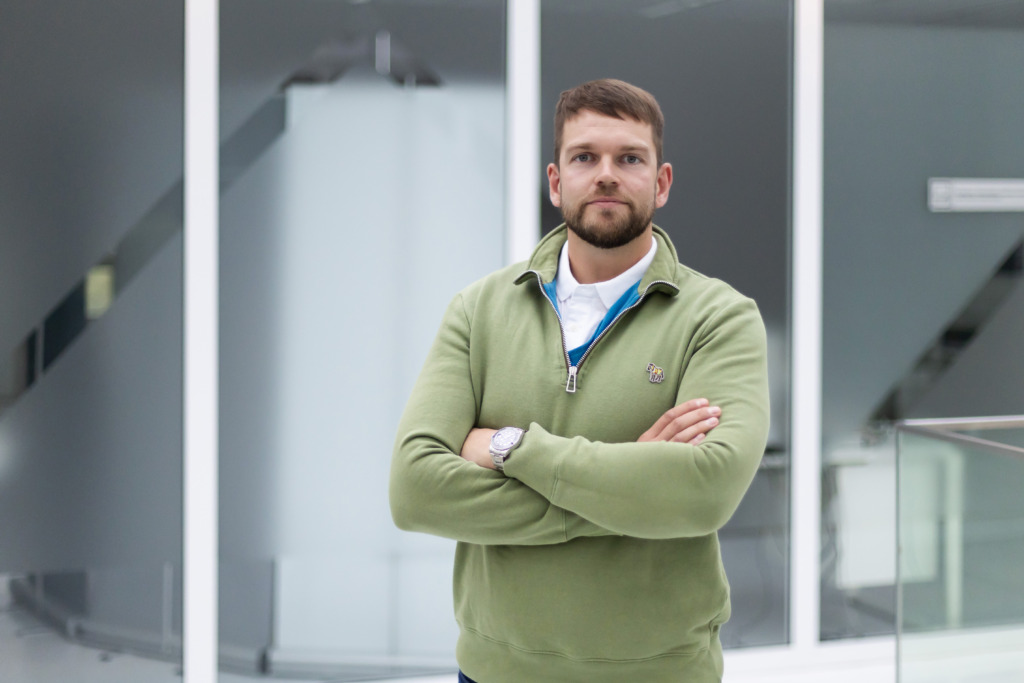
Jonas Paulauskas, Head of Strategic Management Hub at SustAInLivWork

This flexibility is also important for the practical application of the quadruped robot itself. Different sensors can be integrated into the robot, allowing the platform to be adapted to a variety of tasks.

“We will be able to feed the data they collect into artificial intelligence models, which will analyse it and support decision-making. There is a wide range of potential applications, from monitoring animals or the environment to inspecting manufacturing, energy or transport infrastructure,” says Paulauskas.

Businesses Will Be Able to Bring Specific Problems to The Centre

The new platform is also part of SustAInLivWork’s broader aim to connect research more closely with the real-world needs of businesses and society. According to Paulauskas, valuable research results still sometimes fail to find practical applications. One reason may be the gap between the questions researchers investigate and the problems that businesses and society face in their everyday activities.

The robotics infrastructure is intended to be used according to the same principle. Companies will be able to approach the Centre’s researchers with specific technological challenges, test ideas together and explore potential solutions.

“We are open to collaboration and testing new ideas. Industrial challenges are highly relevant to us, and by joining forces we can find solutions even to complex problems. The robot is only a small part of the Centre’s infrastructure. The expertise and experience of our team are equally important,” emphasises Dr Augustauskas.

Preparing For the Next Wave of Robotics

The Unitree Go2 is just one of several technologies being added to SustAInLivWork’s research infrastructure. The Centre plans to acquire more mobile robotic platforms, industrial robots, drones, industrial camera systems, environmental scanning equipment and equipment for digital data prototyping. Researchers also have access to high-performance computing resources. According to Dr Augustauskas, this infrastructure enables researchers to experiment, solve practical problems, develop projects and test new ideas.

In developing the Centre’s infrastructure, attention is also being paid to technologies that are only beginning to transform the field of robotics. One of these is humanoid robots.

“We can sense that a new wave of robotics is approaching, in which artificial intelligence will increasingly take physical form and be able to perform tasks in real-world environments alongside people. This could fundamentally transform manufacturing, logistics, services and many other areas,” says Paulauskas.

According to him, given the extremely rapid development of AI technologies, it is important for the Centre not only to have a long-term direction but also to remain flexible and capable of responding quickly to new technological developments.

“Our goal is to create a Centre that is strong and flexible enough so that, when the next wave of technology arrives, it will not simply observe it from the sidelines but will be part of it,” says Paulauskas.

SustAInLivWork is the first Centre of Excellence of its kind in Lithuania, systematically bringing together AI knowledge and expertise from four Lithuanian universities – KTU, Vytautas Magnus University (VMU), Lithuanian University of Health Sciences (LSMU) and VILNIUS TECH – in collaboration with partners in Germany and Finland.

The SustAInLivWork project is co-funded under the European Union’s Horizon Europe programme under Grant Agreement No. 101059903 and under the European Union Funds’ Investments 2021–2027 (project No. 10-042-P-0001).