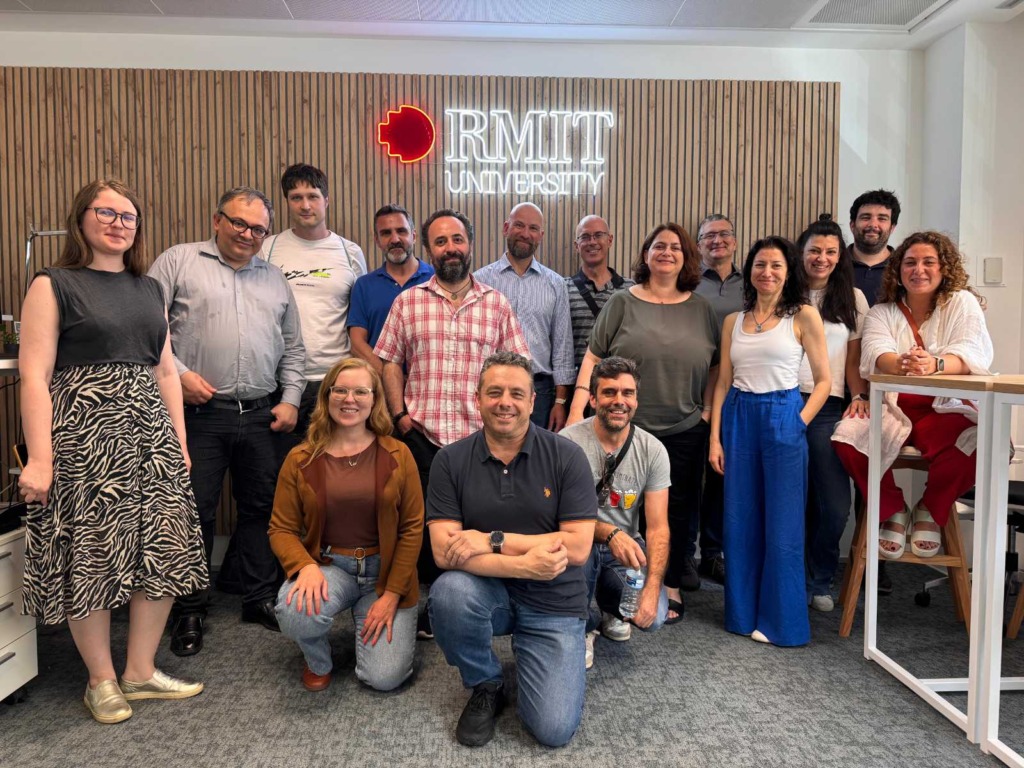
The GenAISA – Generative AI Skills Academy project continues to move forward, with Kaunas University of Technology (KTU) joining partners from across Europe for the second in-person project meeting in Barcelona, Spain. Held on 18–19 June 2025 and hosted by RMIT Europe, the meeting focused on curriculum development, digital learning tools and preparation for future piloting activities.
During the two-day meeting, partners reviewed progress and agreed on the next steps as the project enters its core development phase. KTU contributes to GenAISA by supporting the development of modern, inclusive and labour-market-relevant learning resources in the field of generative artificial intelligence.
Partners also reviewed progress on the MOOC platform and the Digital Skills Passport. The first interactive course module was presented, combining videos, practical tasks and self-assessment activities. The Digital Skills Passport was also demonstrated as a tool for storing micro-credentials and documenting learners’ generative AI competencies.
Another important discussion focused on the GenAI Competence Map and draft ESCO-aligned job profiles, including roles such as Prompt Engineer and Generative AI Engineer. These outputs will be further validated through expert interviews and will later inform both the course content and the Digital Skills Passport framework.
The consortium also discussed preparations for piloting. A pre-pilot phase will help gather feedback on the MOOC platform and Digital Skills Passport before formal testing begins in 2026. The project will maintain inclusive access, with no strict entry requirements for learners.
As the project moves towards piloting and public release, the main next steps include the preparation of draft course modules by 30 September 2025, final online course versions and digital tools by 21 December 2025, testing from January to May 2026, and an open call for learners in June 2026.
Through its participation in GenAISA, KTU continues to contribute to European efforts to strengthen generative AI education and help learners develop the skills needed for an AI-driven future.